Have you ever had a nail break, a screw slip, or an item shake? So when choosing between nails and screws, don’t just pick a fastener that can temporarily fix an item. For safety reasons, be sure to choose the right fastener for each project. This guide will help you solve these confusions using a simple five-element system commonly used by professional builders.
What Are The Core Difference Between Nails And Screws?
Basic Definition
Nail:That is a long metal part with a pointed end. It is usually hammered through materials with the help of a hammer. A flat part of a certain length is left at the other end to facilitate hammering and disperse the pressure to prevent the nail from sinking into the material.
Screw:that is a long, strip-like metal part that is shaped like a spiral. The rod has a spiral thread that can be rotated to “screw in” or “screw out” the material.
Differences In Production Processes
Screws:
- Cold heading: Use a cold heading machine to cut the wire of medium carbon steel (C1022) and punch out screw heads such as hexagonal heads, round heads, etc.
- Thread processing: Use a thread rolling machine or a thread rolling machine to roll out threads on the rod
- Heat treatment: Quenching to increase hardness, tempering to eliminate internal stress.
- Surface treatment: Electroplating (galvanizing, nickel, chromium), blackening, phosphating or Dacromet coating.
- Sorting and packaging: Check the thread accuracy, size and strength.
Nails:
- Wire drawing: The steel used for drawing low carbon steel (Q195, Q235) is drawn to the required diameter.
- Cold heading or hot rolling: The cold heading machine directly punches out the nail head and cuts it off by the die to form the tip.
- Surface treatment: simple galvanizing, painting or phosphating (low anti-rust requirements).
- Packaging: No high-precision sorting is required, and it can be packaged directly according to specifications.
Differences In Structural Design
Nail:
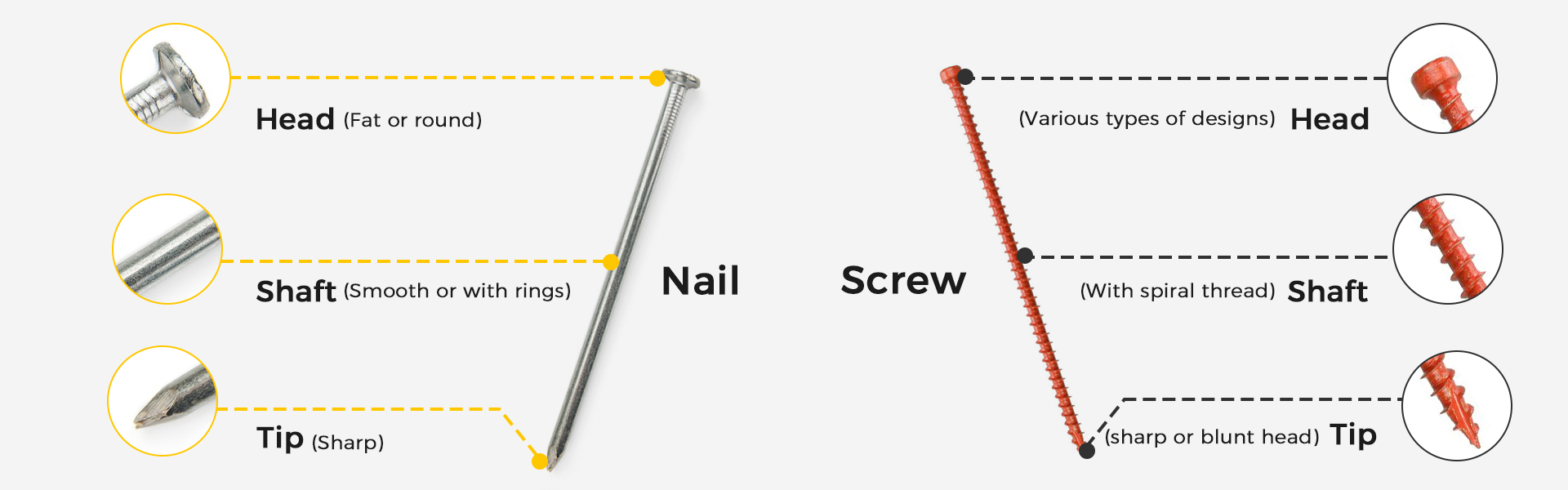
Head: flat or round, used to disperse hammering pressure or hang objects.
Shaft: smooth or with rings, ring nails can increase friction and be more secure
Tip: sharp, can reduce penetration resistance when striking.
No thread: relies on material deformation to generate friction.
Screws:
Head: various types of designs, such as flat, cross, hexagonal, Trox, Square, etc., can provide a rotary drive interface.
Shaft: with spiral thread, divided into full thread or half thread, coarse thread and fine thread, high and low thread
Tip: sharp (self-tapping screw) or blunt head (pre-drilling required).
Thread parameters: pitch, angle, depth affect the fixing strength, such as fine thread is suitable for metal, coarse thread is suitable for wood, etc.
Differences In Application Scenarios
Nail:
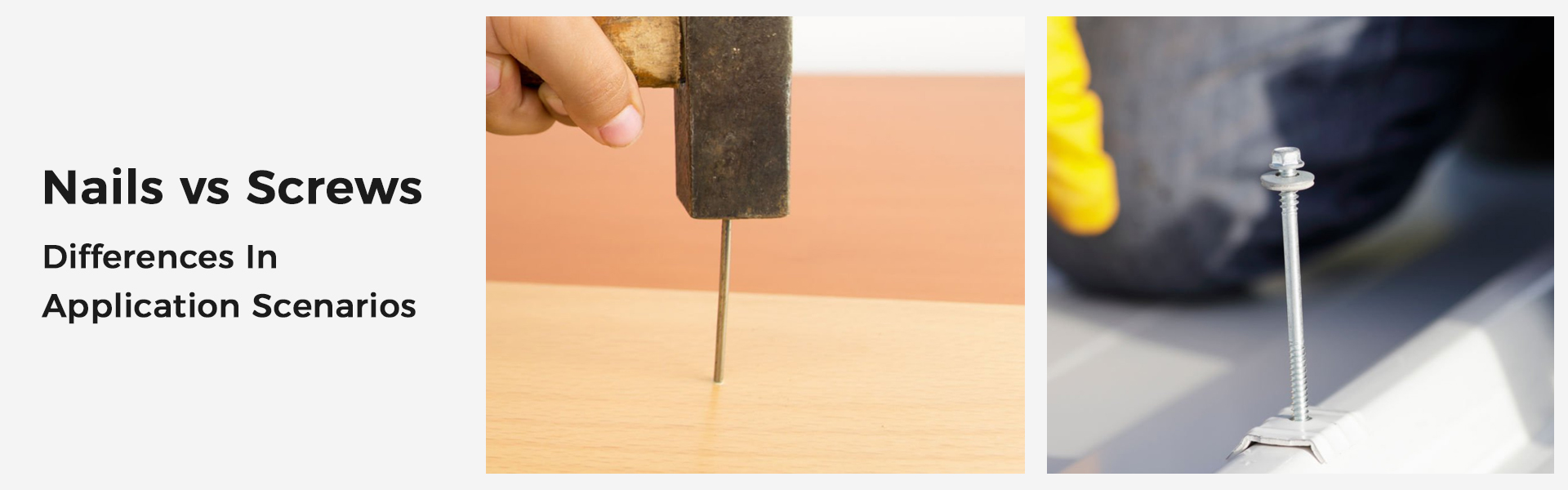
Nail (nail) Applicable scenarios: used for one-time fixing or static load-bearing scenarios, such as carpentry, construction, etc.
Quick construction: building frames, roof tiles, floor laying can be used with nail guns to improve work efficiency
Static load: fix wooden boxes, fences, decorative lines that do not require frequent vibration
Low-cost requirements: temporary structures, disposable packaging.
Material compatibility: soft materials such as wood and gypsum board.
Screws:
Screw (screw) Applicable scenarios: used for scenarios that need to be disassembled, reused or subjected to dynamic loads, such as mechanical assembly, electronic products, etc.
High-strength connection: mechanical equipment, furniture assembly requires shear resistance and vibration resistance
Detachable requirements: electronic equipment, automotive parts are easy to repair and upgrade
Hard materials: metal plates, concrete, but need to be used with expansion screws or self-tapping screws
When to use nails?
Pursuit of efficiency: Need for quick installation (e.g. nail guns are faster than screws).
Low-cost projects: Limited budget and no need for frequent disassembly (e.g. pallet production).
Fixing soft materials: Wood, plastic foam (nail deformation can fix).
Concealment needs: Headless nails (e.g. Brad Nail) are used for decorative projects, leaving no marks on the surface.
Example:
When building a wooden house frame, use ordinary round nails to quickly fix beams and columns.
When installing skirting, use headless nails to hide the fixing points.
When choosing screws?
Need to resist vibration/tension: Furniture, mechanical parts (screws have strong pull-out resistance).
Detachable needs: Electronic products, DIY furniture (home and office furniture often use screws).
Connection of hard materials: Metal plates, concrete walls (self-tapping screws or expansion screws).
Precision control: Need to adjust the depth or angle (e.g. mirror installation).
Example:
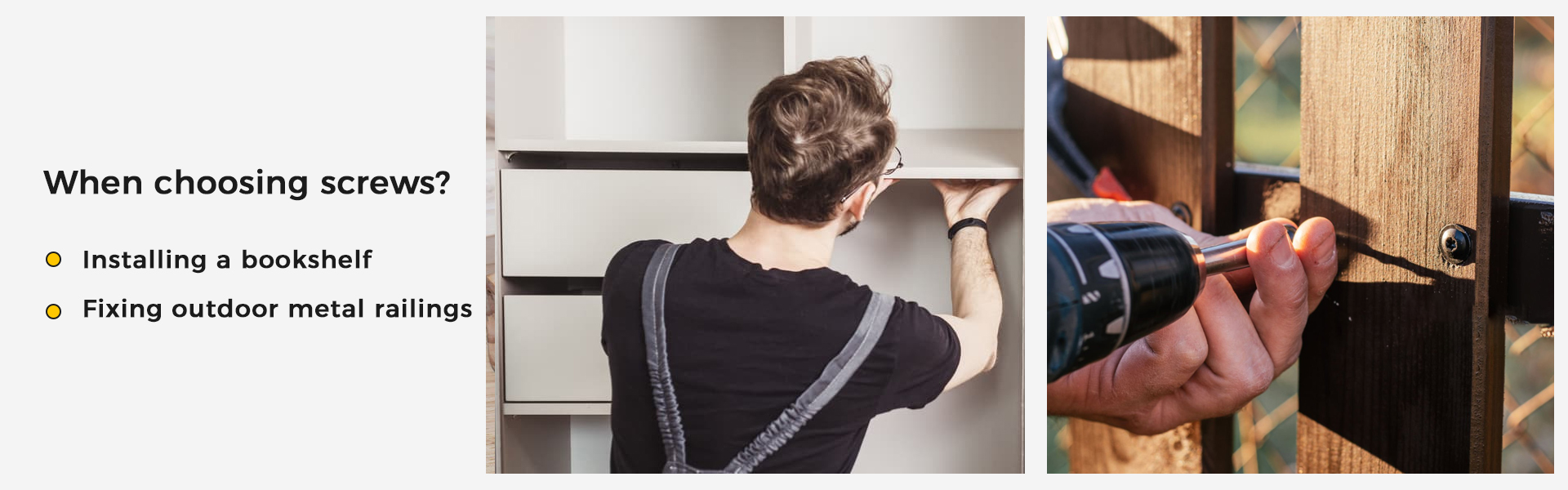
When installing a bookshelf, use wood screws to ensure that the shelf is stable in load bearing.
When fixing outdoor metal railings, use stainless steel screws to prevent rust.
FAQ Section
Q: “Can I substitute screws for nails in framing?”
A: Yes, but expensive – Structural screws cost 5 times more than nails and require special tools.
Q: “Why do my deck nails keep popping up?”
A: Wood shrinks as it dries – use threaded nails or screwshell composite nails instead.
Q: “Best fastener for concrete to wood?”
A: Concrete screws (with nylon anchors) beat any nail.
Summary
Through this article, we can see that screws have a more complex production process, higher precision, and higher material cost, and are suitable for precision fastening; nails have a simple process, high efficiency, and low cost, and are suitable for quick fixation. Choosing fasteners suitable for your project based on different functional requirements can not only save costs, but also ensure the firmness and safety of the project.