We all know screwdrivers – they’re workhorses in every toolbox, garage, and kitchen drawer. At its heart, a screwdriver (whether hand-powered or electric) does one thing beautifully: it puts screws in or takes them out.
Here’s the simple magic:
You twist the handle, and that twist travels straight down the shaft right into the screw head. That’s torque doing its job – driving the screw deeper to tighten things up, or reversing it to wrestle a stuck screw loose.
What makes a good one? Let’s break it down:
- The Handle: This is where you connect. It needs to feel good and not slip, especially when you’re leaning into it. You’ll find them in grippy rubber, tough plastic, or solid wood – shaped just right for comfort and control.
- The Shaft (or Blade): This tough metal rod links your hand to the business end. It has to be stiff and strong to handle all your twisting force without bending or snapping. Stuff like chrome-vanadium steel is common because it’s tough as nails and won’t twist apart.
- The Tip: This is the critical part. It’s got to bite into those tiny grooves on the screw head perfectly. If it doesn’t fit just right, you’re headed for stripped screws and frustration. It’s like a key fitting a lock – precision is everything.
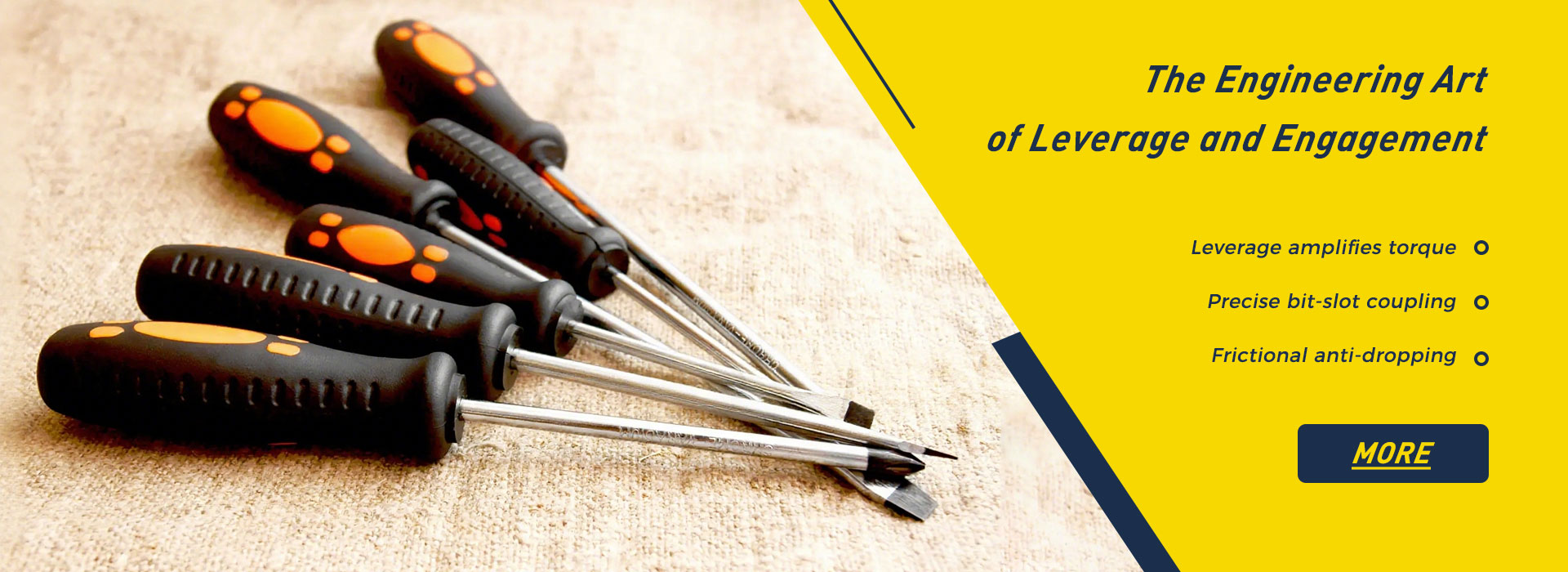
1.Working Principle: The Engineering Art of Leverage and Engagement
The working principle of a screwdriver perfectly blends classical physics with precision mechanical design:
Leverage amplifies torque: The handle acts as a lever arm, and the force applied by the wrist is amplified through leverage into a rotational torque at the bit.
Precise bit-slot coupling: The bit geometry (e.g., the four-way radial wings of a Phillips head) must fully engage the corresponding groove in the screw head (e.g., a Phillips slot). This coupling ensures efficient transmission of rotational force and minimizes sliding losses.
Frictional anti-dropping: The bit surface is often sandblasted, magnetized, or specially textured to increase friction with the screw slot, preventing accidental dropout during operation.
Electric/Power Screwdriver: A built-in micromotor converts electrical energy into rotational kinetic energy, which is then increased through a planetary gear set to drive the bit. Cordless screwdrivers are powered by lithium-ion batteries, eliminating the need for cables and significantly improving operational flexibility.
2.Complete list of screwdriver types: Made for every screw
There are many types of screwdrivers, which can be divided into the following categories based on the blade geometry, drive method and special functions:
(1) Types of Screwdrivers
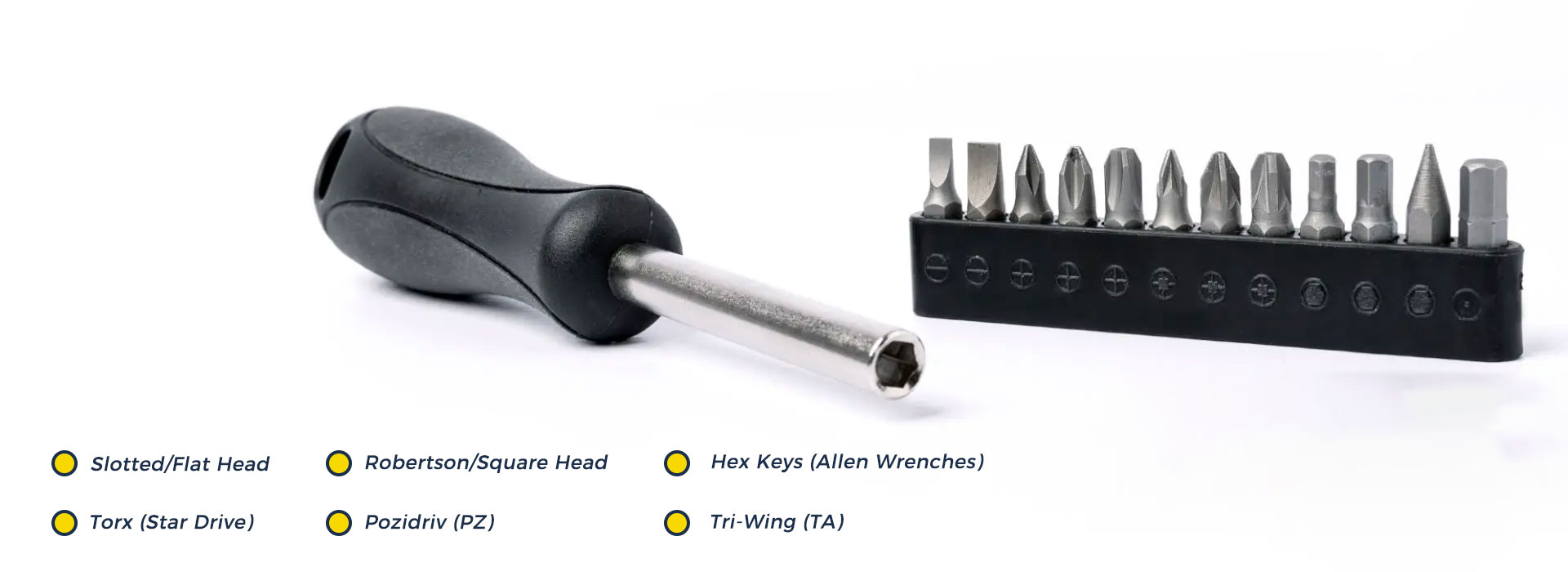
Slotted/Flat Head: The oldest type, with a single flat wedge-shaped blade. Suitable for simple, low-torque applications, but prone to slippage.
Phillips Head (PH): Cross-shaped grooves, with a certain degree of self-centering, more anti-slip than the flat head. PH1, PH2 (most commonly used), and PH3 are common specifications.
Robertson/Square Head: Common in Canada, with a square cone-shaped blade that fits tightly and has high torque transmission efficiency.
Here’s a human-centered rewrite that sounds like it comes from a seasoned mechanic or builder:
Hex Keys (Allen Wrenches):
You’ve definitely wrestled with these L-shaped pieces of metal. They slot into hexagonal sockets – super common in flat-pack furniture, bike parts, and machinery. Just grab the right size and crank.
Torx (Star Drive):
- Regular Torx (T-Series): See that star-shaped pattern? That’s Torx. It bites way better than a standard Philips – way less likely to slip or strip out when you’re laying down serious torque. That’s why you’ll find these little stars holding together your car, laptop, and game console.
- Security Torx (TR): Spotted one with a tiny pin right in the middle of the star? That’s the tamper-proof version. Don’t even try using a regular Torx bit on it – you need the special Security Torx bit with the hole drilled up the center, or you’ll just wreck the screw.
Pozidriv (PZ): Similar to a Phillips head but with additional 45-degree teeth. Not fully compatible with Phillips, it is common in Europe and primarily used in woodworking and construction.
Tri-Wing (TA): Features a three-winged groove, primarily used for tamper-proofing electronic products.
Y-Point (Y-Type): Features a three-pronged star shape, commonly found on electronic products such as game consoles and mobile phones.
Socket Screwdriver: The blade is a detachable socket, which can be used with hexagonal, dodecagonal or special bolts and nuts of different sizes.
(2) Classification by drive/function
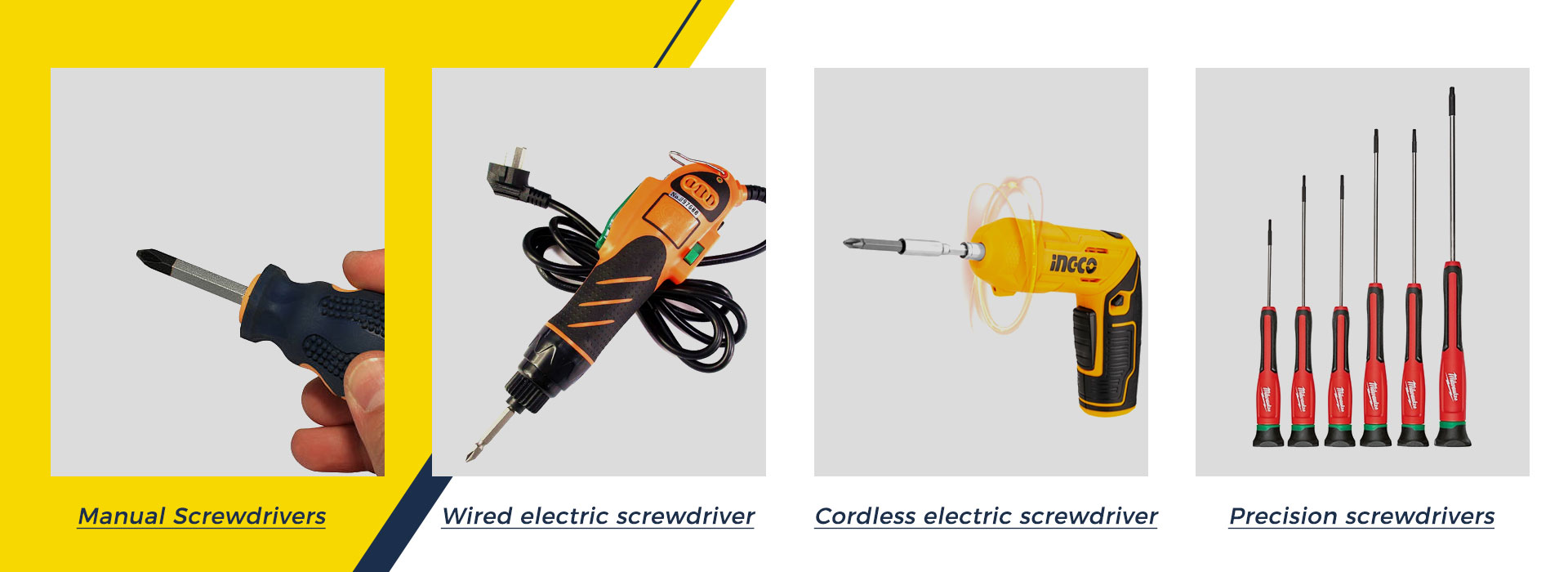
Manual Screwdrivers: Purely human-driven, reliable.
Standard type: Fixed blade or replaceable blade.
Ratchet Screwdriver: The handle has a built-in ratchet mechanism, which allows one-way rotation and force application. The handle can be quickly reset when tightening/loosening, saving time and effort, and is especially suitable for space-constrained occasions.
Electric/Power Screwdriver:
Wired electric screwdriver: Continuous power supply, stable power.
Cordless electric screwdriver: The mainstream choice, portable and flexible, the voltage (such as 3.6V, 12V, 18V) determines the power and battery life.
Impact screwdrivers: Superimpose high-frequency, instantaneous impact force (hammering) on rotation. Designed specifically for removing rusted and overtightened screws, they are particularly suitable for automotive repair and heavy machinery. Avoid using them on precision electronic equipment!
Precision screwdrivers: Compact in design and with a variety of blade sizes (such as PH000 and T3), they are used for repairing precision equipment such as glasses, watches, mobile phones, and laptops.
Torque screwdrivers: Preset or displayed torque values ensure precise and consistent tightening force, making them crucial for automotive assembly, aerospace, and precision instrument manufacturing. Available in mechanical dial, digital, and adjustable preset models.
3.Professional Usage Guidelines and Safety Guidelines
Precise matching is the golden rule: the blade size and type must 100% match the screw head. After visual inspection, gently test the coupling. Any looseness can cause thread stripping and serious damage to the screw and workpiece.
Apply vertical force and steady rotation: Keep the tool shank perpendicular to the screw axis. Apply steady axial pressure while rotating the tool handle at a constant speed. When starting a power tool, firmly press the screw to prevent the tool tip from jumping out.
Ergonomic grip: Grip the tool handle with your entire hand (not your fingertips), using your arm and body strength to drive the tool, avoiding wrist strain.
Utilize the power function:
Most cordless screwdrivers have a torque adjustment ring (1-15+ levels). Adjust the setting based on screw size and material hardness (low for plastic/small screws, medium-high for wood/metal). It’s better to use a low setting than a high setting to avoid stripping or breaking the screw.
After tightening with the power tool, it’s recommended to manually tighten the screw by lightly half a turn to confirm tightness.
For removing stubborn screws, consider an impact screwdriver, but ensure the workpiece is secure.
Always remember to work safely:
Safety first – no exceptions:
Don’t even think about using striking tools or prying rusty metal without safety glasses. Flying grit and shards will find your eyes – guaranteed.
When dealing with live wires or circuit boards? Only trust a 1000V-insulated screwdriver. Using a regular one here is literally gambling with your safety.
Lock it down:
Always clamp your workpiece in a vise or fixture before you turn that first screw. If it shifts mid-job, you’re risking smashed fingers or a ruined part.
Pace yourself:
Cranking screws for hours wears you out fast. Bad posture sneaks up on you, too. Stop, stretch, and reset regularly – your back will thank you later.
Tools matter – buy smart:
Skip the junk drawer rejects. Grab a quality precision screwdriver set from a trusted name like Wera, Wiha, PB Swiss, or Vessel. Make damn sure it covers these essentials:
Cross-head (Phillips): PH00, PH0, PH1, PH2
Flat-head (Slotted): 2mm, 2.5mm, 3mm, 4mm
Torx (Star): T3, T4, T5, T6, T7, T8, T9, T10
Hex (Allen): 0.7mm, 0.9mm, 1.3mm, 1.5mm, 2mm
Power Tools: Pay attention to battery voltage (determines power), capacity (Ah, which determines battery life), speed (RPM), maximum torque (Nm), and whether it’s a brushless motor (for greater durability and efficiency).
Specialized Supplement:
Auto/Motorcycle Repair: An impact screwdriver set (including slotted and Phillips impact bits of varying sizes) is essential.
Precision Electronics/Model Making: A precision Torx (T-series) screwdriver set (such as the T2-T10) and a JIS-standard Phillips screwdriver (which offers better compatibility than Phillips and reduces the risk of thread stripping on Japanese electronics).
For precision assembly work: Don’t skip getting a good torque screwdriver – one where you can actually set the tightness you need.
What really matters:
- Blade Steel: Go for S2 alloy steel. It’s the top-shelf stuff – crazy hard, won’t chip easily, and lasts forever without wearing down.
- Magnet & Grip: Strong magnets are a lifesaver – they lock onto screws so you don’t drop them. And that grip? Look for blades treated with something special to stop slipping (Wiha’s “MicroFinish” is killer for this).
- Feel in the Hand: How it fits your hand makes or breaks it. The shape and material decide if it’s comfy and lets you turn it efficiently. Seriously, try holding it before you buy if you can.
Power Tools: Pay attention to battery voltage (determines power), capacity (Ah, which determines battery life), speed (RPM), maximum torque (Nm), and whether it’s a brushless motor (for greater durability and efficiency).
Conclusion:
Whether you’re tinkering with electronics, repairing heavy machinery, or just tackling a weekend project, a reliable set of screwdrivers—including classic flat-head screwdrivers, Phillips-head screwdrivers, Torx screwdrivers, and star-shaped screwdrivers—is essential. Each screwdriver in the set locks perfectly into those tiny screw slots, transforming your twisting motions into precise control, making the most of them. They’re more than just metal rods; they’re essential tools for anchoring our crumbling world and fixing broken things.