Self-tapping screws, or quick-thread screws, are a special type of fastener that can cut by itself. The specially designed threads and tips can directly cut or extrude matching threads on the substrate, achieving fast and efficient fastening. They can be directly installed without pre-tapping, greatly improving work efficiency. Its core feature is the unique thread design – sharp cutting edge (Type B) or high-pressure formed thread (Type A), which can be adapted to a variety of materials such as metal, plastic, and wood. Self-tapping screws have limited penetration ability and are usually suitable for metal plates ≤6mm. Thicker materials require pre-drilling. They are often confused with Self-Drilling Screws, but the latter come with a drill bit and can drill thicker materials.
Self-Tapping Screw Types: The Complete Guide
Classification By Head Style
- Flat Head Self Tapping Screw (Countersunk Head) Conical design, the screw is flush with the material surface after installation, but it needs to be used with countersunk holes. It is suitable for installation of furniture, precision instruments, etc. that require a flat appearance. The drive mode can be selected from Phillips/Slotted/Torx Drive
- Pan Head Self Tapping Screw (round head) has a semicircular ridge on the head, and a large contact area to prevent loosening. It is suitable for installation of electrical housings and mechanical shields. The drive method can be selected phillips/hex socket
- Truss Head Self Tapping Screw (large flat head) the head has a large diameter but low height. This design can effectively disperse pressure and prevent thin plates from deforming. It is suitable for the installation of sheet metal and plastic shells. The optional drive mode is phillips/slotted drive
- Button Head Self Tapping Screw (dome head) hemispherical decorative head with rounded appearance, suitable for exposed installation or car modification, high-end furniture installation, optional drive mode hex socket/torx
- Hex Head Self Tapping Screw (external hexagon) hexagonal shape can be tightened directly with a wrench, can withstand high torque, suitable for fixing and installing steel structures and heavy equipment, optional drive mode wrench/socket
- Bugle Head Self-Tapping Screw,the head is a gradually expanding flare (20-22° cone angle), which can automatically sink into the material surface during installation without additional countersinking. The edge is smooth to avoid tearing the surface of fragile materials such as gypsum board and wood. Suitable for fixing gypsum board to wooden or metal keels, with various drive methods (phillips ph2),torx (star t20/t25), robertson drive

Classification By Thread Type
- Coarse thread, large thread pitch (8-12 TPI), strong grip, and anti-cracking of materials Suitable for wood, plastic, and soft metals
- Fine thread, small thread pitch (24-32 TPI), can accurately bite the material, effectively prevent loosening, suitable for steel plates, aluminum, hard plastics
- Hi-Lo Thread, alternating high and low threads, both speed and locking force, suitable for wood-metal hybrid structures
- Full Thread, the thread covers the entire shaft, enhancing the overall strength and suitable for thin material connection (≤3mm)
- Partial Thread, only the shaft part has threads, reducing costs, suitable for thick material fixing (pre-drilling required)
- Thread-Cutting, with sharp cutting edges, directly cuts the material to form the screw groove.Suitable for thin metal sheets (≤2mm) and hard plastics.
- Thread-Forming uses pressure to plastically deform the material to form threads without cutting.Suitable for soft metals, plastics, and cork.
Classification By Tip Type
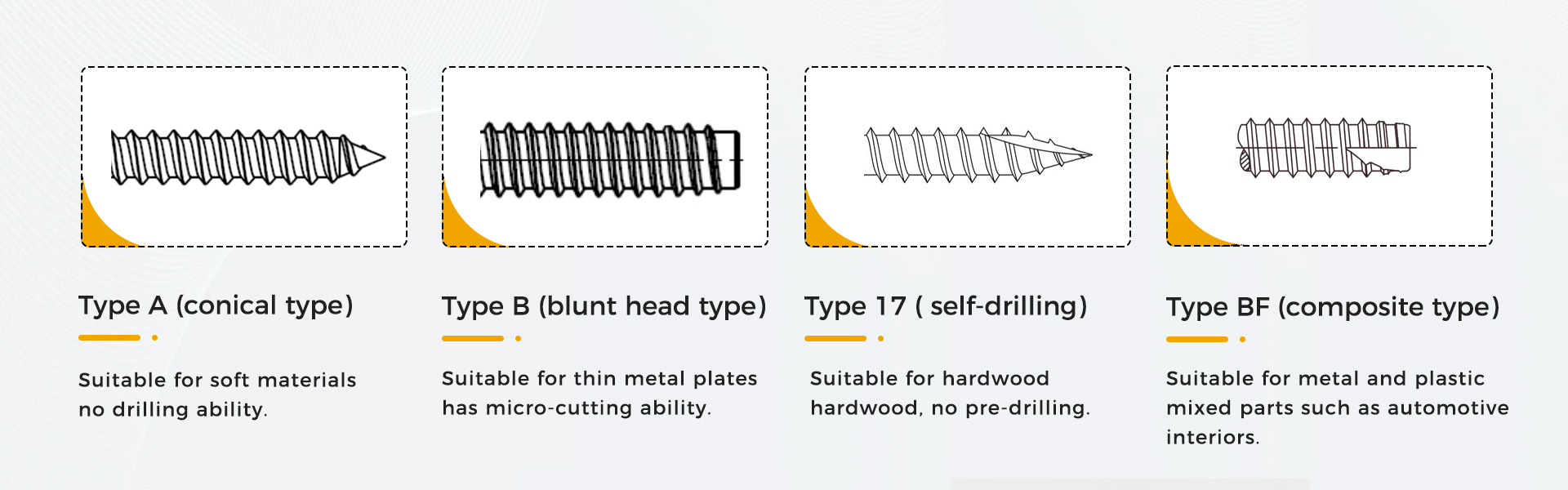
- Type A (conical type) has a sharp tail, is suitable for soft materials, has no drilling ability, is suitable for plastics and cork, and requires pre-drilling.
- Type B (blunt head type) has a flat tail, is suitable for thin metal plates, has micro-cutting ability, and is suitable for thin plates with a thickness of less than 1.2mm, such as chassis, ventilation ducts, etc.
- Type 17 (woodworking self-drilling) has deep chip grooves and sharp drill tips, is suitable for hardwood, hardwood, no pre-drilling, suitable for the installation of solid wood floors and outdoor furniture.
- Type BF (composite type) combines the characteristics of Type A/B and has strong versatility. It is suitable for metal and plastic mixed parts such as automotive interiors and home appliances.
Classification By Coating
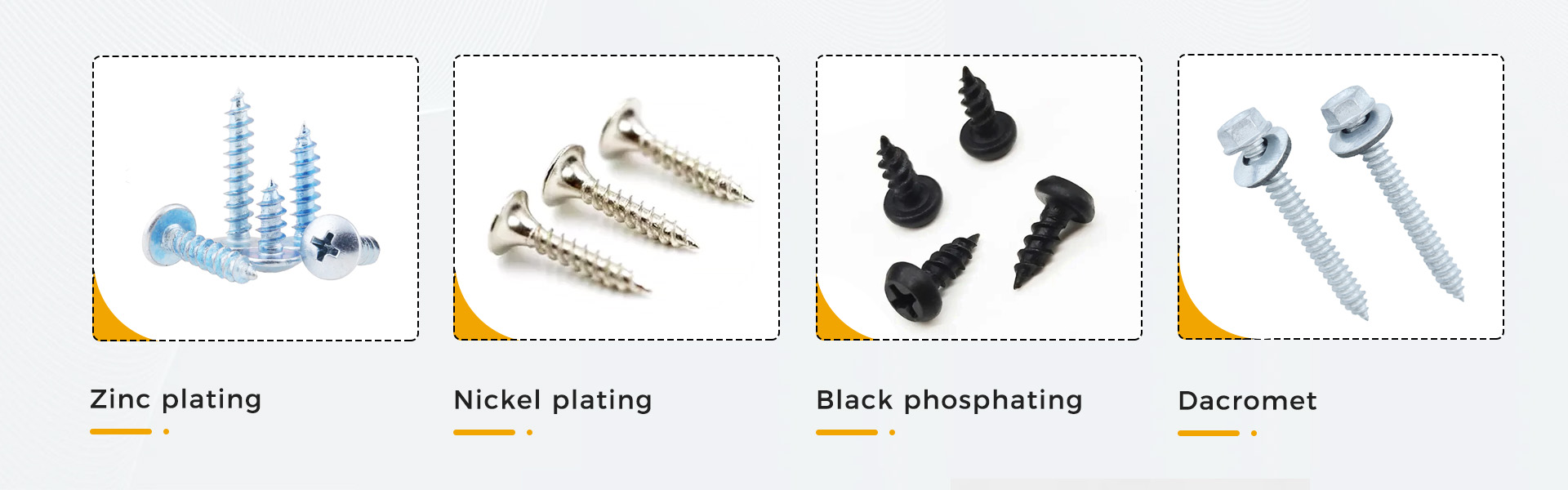
- Zinc plating is a basic protection, available in white, blue and color, suitable for indoor or short-term outdoor use, and can prevent rust and corrosion for 1-2 years
- Nickel plating has high gloss and chemical corrosion resistance, suitable for high humidity or weak acid environments (5 years+), such as kitchen equipment, medical equipment, etc.
- Black phosphating has a matte black surface, and its anti-rust and anti-corrosion ability is average, suitable for dry indoor environments, such as industrial machinery or concealed installation
- Dacromet is a multi-layer composite coating with super high anti-corrosion performance, suitable for heavy industry or coastal areas Bridges or power towers installation
How To Choose Self-Tapping Screws
- Mixed materials: Choose double-thread screws (coarse threads on the upper part for wood, fine threads on the lower part for metal)
- Anti-loosening treatment: Choose washer-type or hexagonal screws for vibration environments
- Efficiency optimization: Choose Collated Screws for batch operations
Avoidance guide:
- Do not use Type A for metal (threads will break)
- Screwing hardwood directly without pre-drilling will cause the screw to break
How to install the Self-Tapping Screw
The key to installing self-tapping screws is “matching materials, controlling depth, and choosing the right tools”:
- Material pretreatment: hardwood/thick metal needs to be pre-drilled (hole diameter = screw diameter × 0.8);
- Vertical feeding: keep the screw at a 90° angle to the surface to prevent thread slippage;
- Torque control: adjust the power tool to medium or low speed (1,500-2,000 RPM), and the countersunk screw needs to stop when the head is flush with the surface;
- Debris cleaning: blow out the residue in the hole after metal/plastic installation to ensure that the thread is fully engaged.
Step-by-step installation guide
- Preparation-Tool selection:
Metal/hardwood: torque-adjustable electric drill (with clutch) is recommended
Plastic/softwood: manual screwdriver is safer
Protective gear: non-slip gloves + goggles (metal chips are easy to splash)
- Screw installation
Step 1: Align the screw tip vertically to the hole and apply slight downward pressure
Step 2: Start the tool at a constant speed without tilting or shaking
Step 3: Stop when the screw head reaches the following state:
Countersunk screw: flush with the material surface (±0.3mm)
Round head/hexagonal head: completely close to the material without gaps
Conclusion
Understanding the correct selection and installation techniques of self-tapping screws can easily help you choose the most ideal screws for your own projects or customers, which can significantly improve the construction quality or sales profits.
If you need to know more about screws, please contact us. Sinsun multi-functional self-tapping screw series, a one-stop solution to complex fastening problems!